
Recently, the research team of Professor Liu Yong from the School of Materials Science and Engineering at Beijing University of Chemical Technology published a review article titled "Green Solvent-Based Chemical Recycling of Wind Turbine Blades: Recovery and Reuse of Recyclates" in the internationally renowned journal Progress in Materials Science (Impact Factor: 42.9). As the global deployment of wind energy continues to accelerate, the management of end-of-life wind turbine blades has emerged as a critical sustainability challenge. Conventional disposal methods such as landfilling and incineration are environmentally undesirable and result in the loss of valuable resources. The paper innovatively highlights environmentally benign, green solvent-based chemical recycling as a promising strategy to address this challenge and to facilitate the transition toward a circular economy for fiber-reinforced polymer composites.
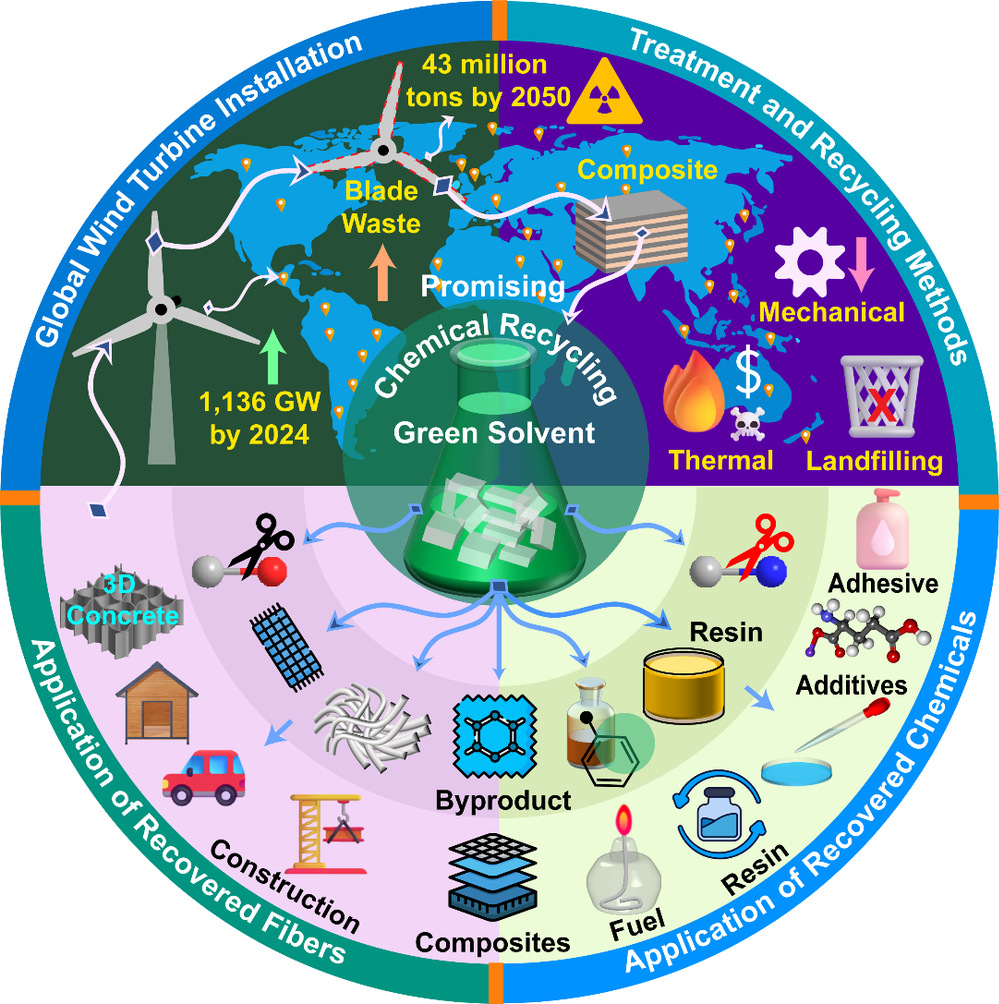
Green Solvent-Based Chemical Recycling of Wind Turbine Blades and Reutilization of Recyclates.
Furthermore, the review provides an integrated perspective at the intersection of materials science, chemistry, and environmental engineering, highlighting both the opportunities and challenges associated with developing scalable and sustainable chemical recycling solutions for next-generation wind turbine blades. Among the available approaches, green solvent-based techniques have demonstrated significant potential for efficiently recovering both glass and carbon fibers from end-of-life wind turbine blades while depolymerizing waste resin matrices into valuable small-molecule chemical feedstocks, thereby offering enhanced economic and environmental benefits.
The review serves as a valuable resource for researchers, industry stakeholders, and policymakers advancing sustainable composite recycling and circular wind energy technologies. Moreover, it provides a pioneering and comprehensive perspective on developing greener, more efficient, and economically viable recycling strategies for polymer composite waste, addressing a key challenge associated with the rapid expansion of renewable energy infrastructure. By highlighting recent breakthroughs, emerging opportunities, and remaining technological barriers, the review supports the broader transition toward a sustainable circular economy within the renewable energy sector. As such, it offers an important reference for researchers at the forefront of sustainable composite materials, renewable energy systems, and green chemistry, while underscoring the authors’ ongoing commitment to advancing environmentally responsible materials science and engineering.
Original article link:
https://doi.org/10.1016/j.pmatsci.2026.101772

